
The 2016 quarter is not one coin. It is a full-year set built around five different America the Beautiful designs. That is the first point to keep clear. A collector who says “2016 quarter” may mean one coin from circulation, a full P and D set, a proof group, or a larger set with silver proofs and San Francisco collector strikes. The year is not rare. It is still worth studying. The appeal comes from structure, variety, and the number of ways the set can be built.
This is why 2016 works well as a collector year. The designs are different. The formats are easy to separate. The budget can stay low or move higher depending on the version. A beginner can collect the five designs from the change. A more serious collector can build a matched set with multiple mint marks and finishes. The year gives room to choose.
The Five Designs in the 2016 Set
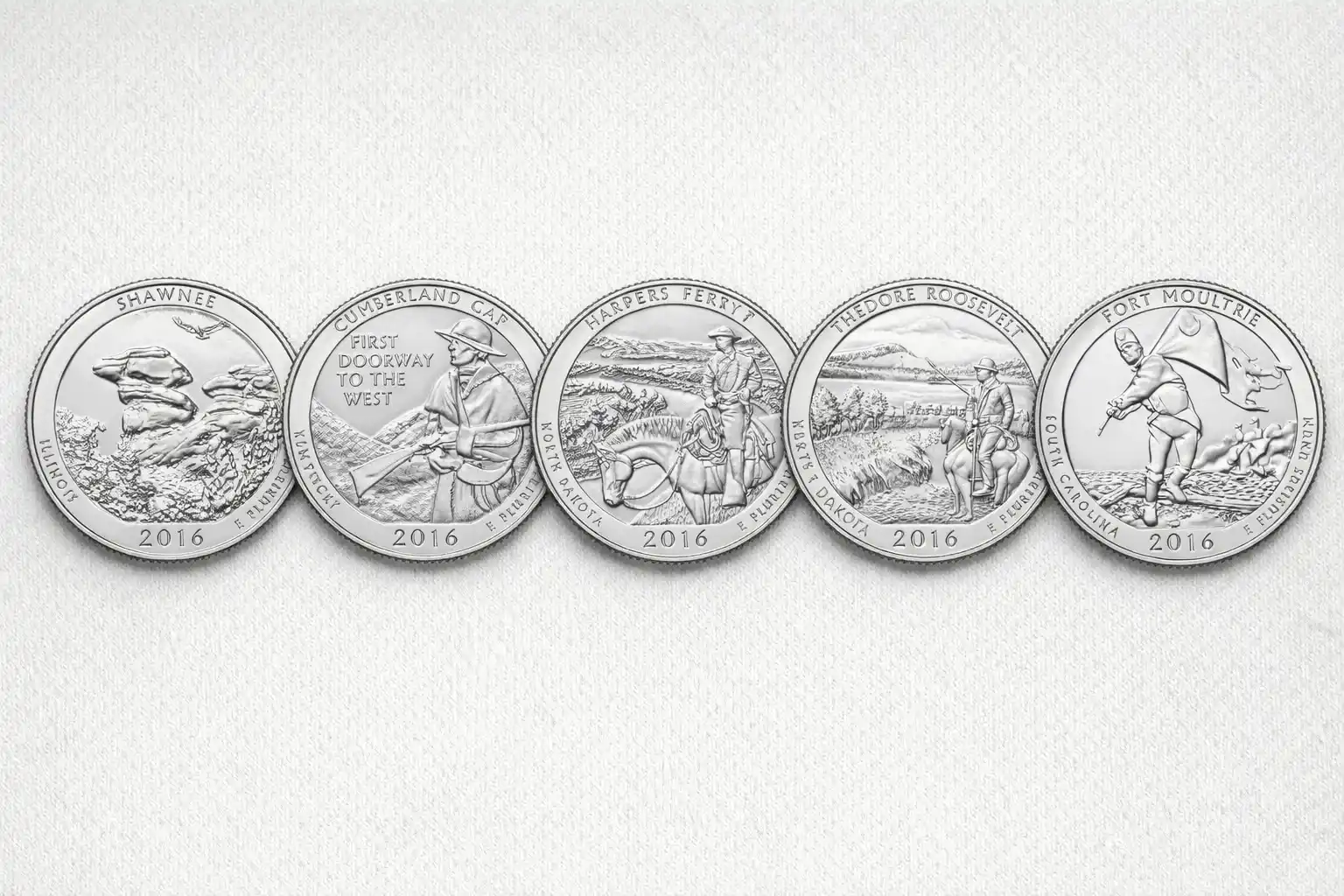
The 2016 quarter year includes five reverse designs. Each one represents a different national site.
| Design | Site | State | Main visual focus |
| Shawnee | Shawnee National Forest | Illinois | Barred owl and forest scene |
| Cumberland Gap | Cumberland Gap National Historical Park | Kentucky | Frontier route and rider |
| Harpers Ferry | Harpers Ferry National Historical Park | West Virginia | John Brown’s Fort |
| Theodore Roosevelt | Theodore Roosevelt National Park | North Dakota | Bison in landscape |
| Fort Moultrie | Fort Moultrie at Fort Sumter | South Carolina | Sergeant Jasper and flag scene |
This is one reason the year works as a set. The reverses do not feel repetitive. A collector gets wildlife, architecture, landscape, military history, and frontier imagery in one group. That gives the set more identity than a year where all coins feel visually close.
What Versions Exist
A full 2016 quarter set can mean different things. The year was issued in more than one format.
| Version | Mint mark | Type | Main collector use |
| Business strike | P | Circulation | Basic set building |
| Business strike | D | Circulation | Date-and-mint set building |
| Clad proof | S | Collector issue | Matched proof set |
| Silver proof | S | Collector issue | Higher-end proof set |
| Uncirculated collector strike | S | Collector issue | Expanded modern set |
That structure matters. Many beginners think the year means five coins. In the simplest form, that is true. For a broader set, the year can mean ten coins, then fifteen, then more if silver proofs and San Francisco collector strikes are included. The year is easy at the start and more technical later. That is a good balance for a modern set.
Basic Technical Profile
The normal circulation quarters and clad proofs use the standard modern quarter composition. The outer layers are copper-nickel over a pure copper core. The silver proofs are different.
| Type | Composition | Weight | Edge | Why it matters |
| Clad circulation and clad proof | copper-nickel over copper core | 5.67 g | Copper stripe visible on edge | Standard modern quarter format |
| Silver proof | 90% silver, 10% copper | 6.25 g | No copper stripe | Separate collector category |
This difference is practical. A collector can check the edge and separate a silver proof from a clad coin quickly. The silver proof is not only a different finish. It is a different metal issue with a different market floor.
Mint Marks and Why They Matter
Mint marks are part of the structure of the year. For the 2016 quarters, the main letters are:
- P for Philadelphia
- D for Denver
- S for San Francisco
For a beginner, mint marks may feel secondary. For a set builder, they are not secondary at all. A five-coin set and a ten-coin P-D set are different projects. Add S proof and S silver proof, and the set changes again.
This is where the year becomes more than a pocket-change group. The same design can exist as:
- A Philadelphia circulation coin,
- A Denver circulation coin,
- A San Francisco clad proof,
- A San Francisco silver proof,
- And a San Francisco uncirculated collector strike.
That is a lot of structure inside one year. Collectors who like organized modern sets usually enjoy that.
Why Collectors Still Care About This Year
The 2016 set is not built on rarity. It is built on completeness. Five designs make a full year. The set also works at several levels.
- A basic collector can build a five-coin design group.
- A date-and-mint collector can build a ten-coin P and D set.
- A proof collector can add the clad proofs.
- A silver-focused collector can choose the silver proof set.
- A modern specialist can add the San Francisco uncirculated issues.
That range is the main appeal. The year can be simple or expanded. The collector does not need to chase key dates to enjoy it. The set itself carries the interest.
The Main Ways to Collect the 2016 Set
The year can be built in several clear formats.
The basic five-coin design set
This is the easiest version. One example of each design. Mint mark does not matter. This is the best starting point for beginners and casual collectors.
The P and D circulation set
This is the next step. Two coins for each design, one from Philadelphia and one from Denver. That gives a ten-coin set. This format feels more numismatic because mint marks become part of the structure.
The clad proof set
This format uses the five San Francisco clad proofs. It works well for collectors who like mirror fields, matched surfaces, and a cleaner presentation.
The silver proof set
This is one of the strongest standard versions of the year. The coins are struck in silver, sold for collectors, and carry both proof appeal and metal value.
The expanded collector set
This is the broad version. It includes P, D, S clad proof, S silver proof, and S uncirculated issues. This is the most complete way to treat the year as a modern collector project.
These formats matter because they change the meaning of the phrase “full set.” A beginner and an advanced collector may both say they own the 2016 set, but they may not mean the same thing.
What Gives the Set Collector Appeal
Several things support the year.
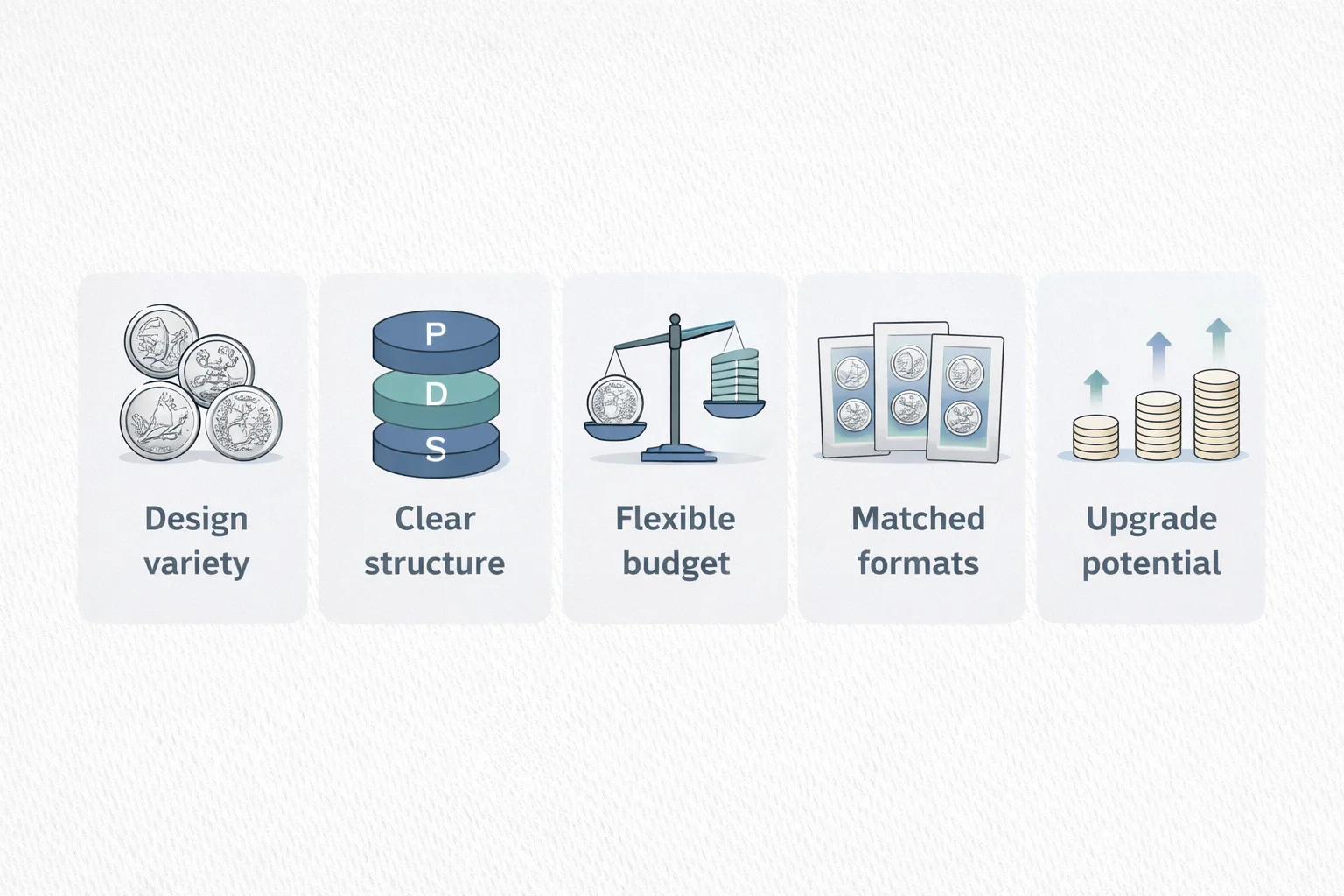
- Design variety. The five reverses are not repetitive. That keeps the set interesting.
- Clear structure. The year is easy to understand. Five designs. Multiple mints. Several finishes.
- Flexible budget. A design set can be very cheap. A proof or silver proof set costs more. The collector can choose the level.
- Matched format. Modern sets often look better when all coins belong to the same type. A full-proof group looks more deliberate than random loose pieces.
- Upgrade potential. A collector can start with the circulated coins and later replace them with cleaner examples, proofs, or silver proofs.
This is why 2016 works. It is not rare, but it is well built.
Where Condition Begins to Matter
Most 2016 P and D quarters are common in circulated condition. The value there stays low. The appeal of the circulation part of the set comes less from rarity and more from completion and eye appeal.
Condition matters more once the collector starts choosing:
- Cleaner business strikes,
- Better uncirculated coins,
- Nicer proofs,
- Stronger silver proofs,
- Or a matched expanded set.
Modern quarters often show marks on Washington’s portrait and in the fields. Proofs can develop haze or spots. Silver proofs add another layer because metal value supports them, but surface quality still matters. A full set with clean, matched coins always feels stronger than a mixed set with average pieces.
In the middle of this process, some collectors can use a free coin identifier tool to separate designs and mint marks before checking the surfaces by hand. That can help with mixed lots, especially when the coins are still loose or grouped by year rather than by issue.
Which Versions Are Most Interesting
This depends on the collector.
The most accessible part of the year is the P and D circulation material. It is easy to find and easy to complete.
The most visually satisfying version is often the clad proof set. All five coins match. The surfaces are more refined. The set looks finished.
The strongest standard format is usually the silver proof set. It combines proof quality with silver content. That gives the year a more serious collector feel.
The most technical version is the expanded set with San Francisco uncirculated issues added. That is where the year starts to appeal more to modern-series specialists.
None of these versions is “correct” for everyone. The right format depends on what the collector wants the set to do.
What People Overestimate
A few mistakes come up often with modern quarter sets.
One mistake is treating every 2016 quarter as scarce. The year is not scarce by date.
Another is paying too much for circulated P or D coins just because they are part of a named national-site program.
A third is mixing clad proof and silver proof values as if they were the same thing. They are not.
A fourth is thinking that low mintage alone makes a modern coin valuable. In many cases, survival and collector demand matter more than the printed mintage number.
A fifth is underestimating the value of a complete matched set. A single common coin may not feel special. A complete year group with consistent quality often feels much stronger.
Who Suits Best This Year?
The 2016 quarter set works especially well for a few types of collectors.
- Beginners who want a complete modern set without much complexity
- Set builders who like a full-year structure
- Modern U.S. coin collectors who enjoy multiple finishes and mint marks
- Proof and silver collectors who want a compact five-coin yearly group
- Casual collectors who like design variety more than strict rarity
It is less ideal for collectors who only want key dates or classic silver series. The year is not built around that kind of scarcity. It is built around format, variety, and set completion.
Conclusion
The 2016 quarter set works because it is complete, varied, and easy to scale. The year is not rare, but it is still a good modern collecting project. The five designs give it identity. The mint marks give it structure. The different finishes give it depth.
That is the real appeal. A collector can approach the year at a simple level or a more advanced one without losing the shape of the set. That makes 2016 stronger than many modern dates that feel flat once the first design group is complete.For first sorting, try the coin finder app. The Coin ID Scanner app confirms the design, mint mark, and issue type from a photo before the final manual review. It can also help with a basic coin card and quick sorting. The final strength of the set still depends on the collector’s choices: which format to build, how clean the coins are, and how complete the year feels once the set is together.